
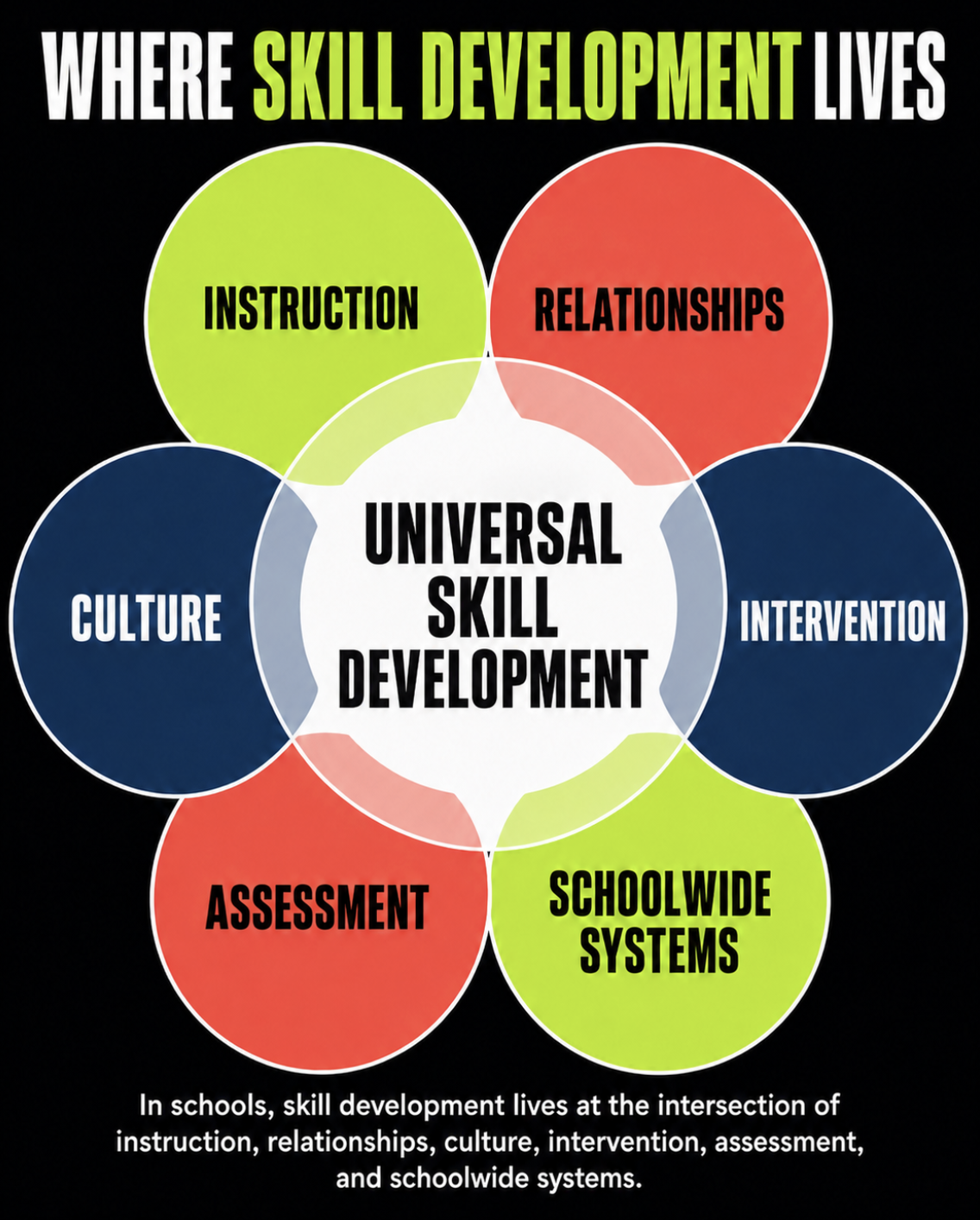
In schools, skill development lives at the intersection of instruction, relationships, culture, intervention, assessment, and schoolwide systems. We help schools and districts use Universal Skills as a shared K-12 foundation rather than adding another stand-alone initiative.
How will we Align Your Systems Around the Skills That Matter?
Schools are doing important work across SEL, MTSS, PBIS, restorative practices, personalized learning, curriculum, interdisciplinary instruction, and assessment—but each system can come with its own language, expectations, and tools. The result can be more complexity rather than greater coherence.
The Universal Skills Project helps schools and districts align these systems around one shared, K–12 language for the skills that matter for learning, relationships, work, and life.
Together, we can reimagine educational systems by intentionally teaching the skills that help people live, learn, and contribute well—not just through stand-alone lessons, but through the holistic integration of skill development across the systems and structures of school.
We work with schools to identify, refine, or develop clear K–12 learning targets that name the skills students are already developing throughout their lives: understanding and developing themselves; considering and connecting with others; approaching ideas and problems with curiosity and critical thinking; and comprehending and communicating effectively.
Those same skills can then become the common thread across:
K–12 learning targets, instruction, assessment, and reporting
SEL instruction and intervention
MTSS, across universal, targeted, and intensive supports
PBIS and schoolwide systems
Restorative practices, reflection, accountability, and repair
Personalized Learning Plans and student goal-setting
Curriculum and proficiency-based learning
Adult learning, professional development, and school culture
Rather than adding another initiative, we help schools connect, simplify, and strengthen the work they are already doing. When Universal Skills become a shared foundation, students encounter the same language across classrooms, relationships, goal-setting, interventions, and moments of challenge. Skills can be explicitly taught, authentically practiced, reflected on, assessed, supported when additional help is needed, and modeled by adults.
Our Values: Centering Growth, Not Compliance
Universal Skills are not a new set of rules for students to follow. They are capacities that children and adults continue developing throughout their lives.
This approach centers children's humanity, relationships, natural interests, identities, and development in learning and goal-setting. Rather than defining success primarily through compliance with adult expectations, we help schools build systems that strengthen self-awareness, autonomy, connection, curiosity, problem-solving, communication, integrity, and contribution.
The goal is to prepare young people not simply to succeed in school, but to leave it able to reflect on who they are, continue developing their skills, build healthy relationships, solve meaningful problems, and contribute to their communities with confidence, integrity, and purpose.
We Help You Build a System That Works for Your Community
There is no single implementation plan that will work for every school.
Drawing on experience in school leadership and district-level social-emotional learning coordination, we understand the realities of implementation: competing initiatives, limited time, existing requirements, staff capacity, sustainability, and the need for change to actually work in practice.
We partner with educators to develop a realistic roadmap for implementation that builds from what is already working. Depending on a school's needs, our work can include developing K–12 learning targets, mapping existing initiatives and systems, creating a common language, aligning practices across universal, targeted, and intensive supports, integrating skills into existing curriculum and structures, and building staff capacity through professional learning and coaching.
The aim isn't to give schools one more thing to do. It's to help the things they're already doing work together.
Fewer silos. Less duplication. One shared language. Skills that grow everywhere.
How can The US Project help?
Develop a Universal Skills roadmap and implementation timeline that builds from existing strengths, priorities, and initiatives.
Develop clear K-12 learning targets for explicit instruction, student reflection, goal-setting, assessment, and reporting.
Build staff understanding and capacity so adults can teach, model, practice, and reflect on the same skills they ask students to develop.
Align PBIS, MTSS/SEL supports, restorative practices, Personalized Learning Plans, advisory or Morning Meeting, curriculum, and proficiency-based learning around a common language.
Connect universal, targeted, and intensive supports so students encounter consistent skill language across classrooms and interventions.
Build sustainable implementation through professional learning, coaching, collaborative planning, and ongoing reflection.
The goal is not one more initiative. It is one shared framework that helps the work already happening across the school work together.
The Skills for School

Sample Implementation Roadmap
Every school’s path will look different. A Universal Skills implementation plan can build from existing strengths and systems while moving toward greater alignment over time.
Develop a Universal Skills Roadmap
Identify priorities, existing structures, opportunities for alignment, and a realistic timeline for implementation.Build Staff Understanding & Capacity
Develop a shared understanding of Universal Skills and build staff capacity to teach, model, practice, and reflect on them across settings.Integrate Skills-Based Restorative Practices
Use Universal Skills as a common language for reflection, accountability, problem-solving, conflict, and repair.Embed Skills in Daily Instruction & Community-Building
Integrate explicit skill instruction into structures such as Morning Meeting, advisory, classroom routines, and authentic learning experiences.Align PBIS with Universal Skills
Connect schoolwide expectations, teaching, acknowledgment, and reflection to the same skills students are developing throughout the school day.Align MTSS & SEL Supports
Use Universal Skills to connect universal instruction with targeted and intensive SEL goals, interventions, and progress monitoring.Integrate Skills into Personalized Learning & Assessment
Embed Universal Skills into personalized learning plans, student goal-setting, reflection, portfolios, assessment, and reporting—giving students an active role in understanding and directing their own growth.
The goal: not another initiative, but one shared framework that connects the work already happening across the school.