
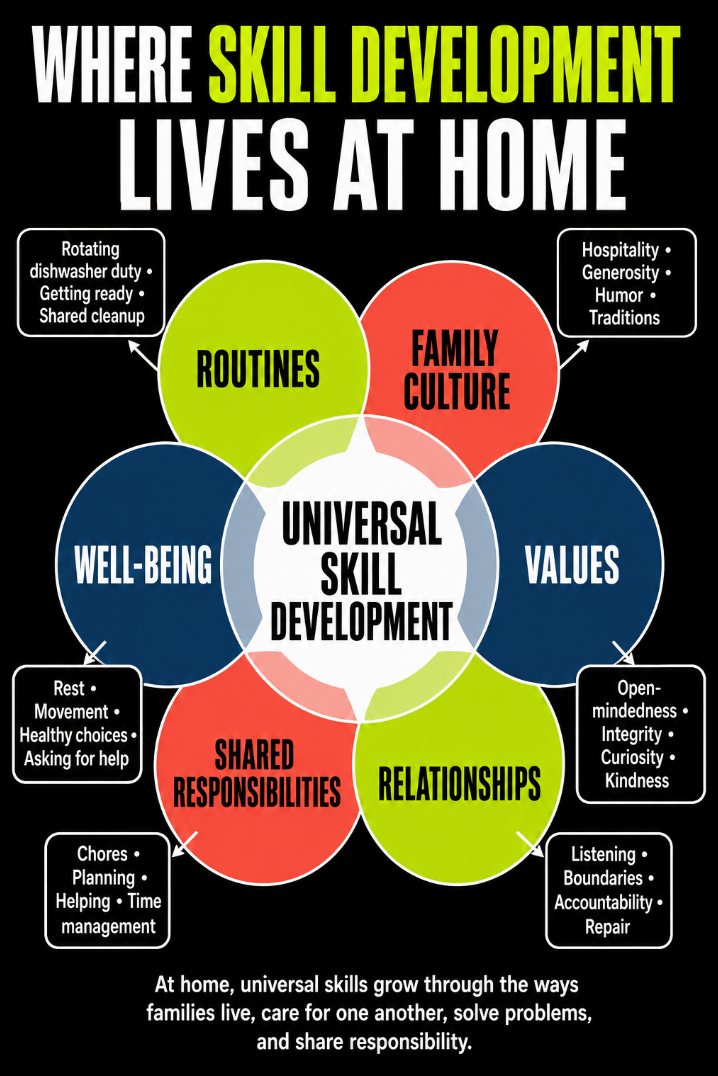
Families are systems too. When one person is struggling, changing, or stuck, everyone is affected. Our family work helps households use Universal Skills as a shared language for growing together - without making one child the problem or asking adults to stand outside the process as judges.
How can the US Project help?
Complete easy to complete family self assessments to identify skill strengths and next steps.
Create a practical Family Home Reset around the patterns that are making home life harder - such as technology overuse, routines, time and attention, conflict, responsibilities, boundaries, or disconnection.
Use coaching to help adults stay grounded, connected, and intentional while children develop increasing autonomy and skill.
Develop shared family language for emotions, values, responsibilities, consideration, communication, problem-solving, repair, and reflection.
Replace repeated correction and power struggles with clearer structures, modeling, reflection, strategic responses, and opportunities to practice skills.
Address technology and media use as a whole-family question about time, attention, priorities, connection, and well-being - not simply as a rule imposed on children.
Create routines and agreements that support a loving, nonjudgmental home while still providing clear boundaries, responsibilities, and follow-through.
Help every family member identify their own growth areas so skill development happens in parallel.
The question shifts from “How do we fix this child’s behavior?” to “What skills do each of us need, and how can our family grow them together?”
The Skills for Families
Who Is Family Support For?
Our US Project family coaching and support is designed for families who want practical, strengths-based help understanding challenges, building skills, and growing together.
We work with:
Children and young people ages 5 and up
Neurodivergent children, teens, and families
Families seeking guidance around technology, media, and screen use
Families who want to intentionally strengthen communication, connection, organization, emotional regulation, or other Universal Skills
Families navigating significant behavioral, emotional, relational, or learning challenges at home or school
Parents and caregivers who want new tools, greater clarity, and a more connected family life
Definitions are vital starting points for the imagination. What we cannot imagine cannot come into being. A good definition marks our starting point and lets us know where we want to end up. As we move toward our desired destination we chart the journey, creating a map.
bell hooks, Writer and Cultural Theorist