
What Makes The Universal Skills (US) Project Different?
Why US?
The Universal Skills Project begins with a simple premise: if a skill is truly universal, everyone should be able to practice it.
Many frameworks designed to support social, emotional, behavioral, or professional growth are built for a particular group of people. There are frameworks for children, frameworks for adolescents, frameworks for employees, frameworks for leaders, and frameworks for families.
Too often, the language used with young people is also embedded with hierarchy and behavioral judgment: be respectful, behave appropriately, follow expectations, demonstrate compliance. (This usually creates a speed bump in skill development progress, since it can elicit a response of annoyance at best and refusal at worst.)
The implicit message can become that one group of people, usually the adults, leaders, teachers, or supervisors, already possesses the skills, while another group needs to learn them.
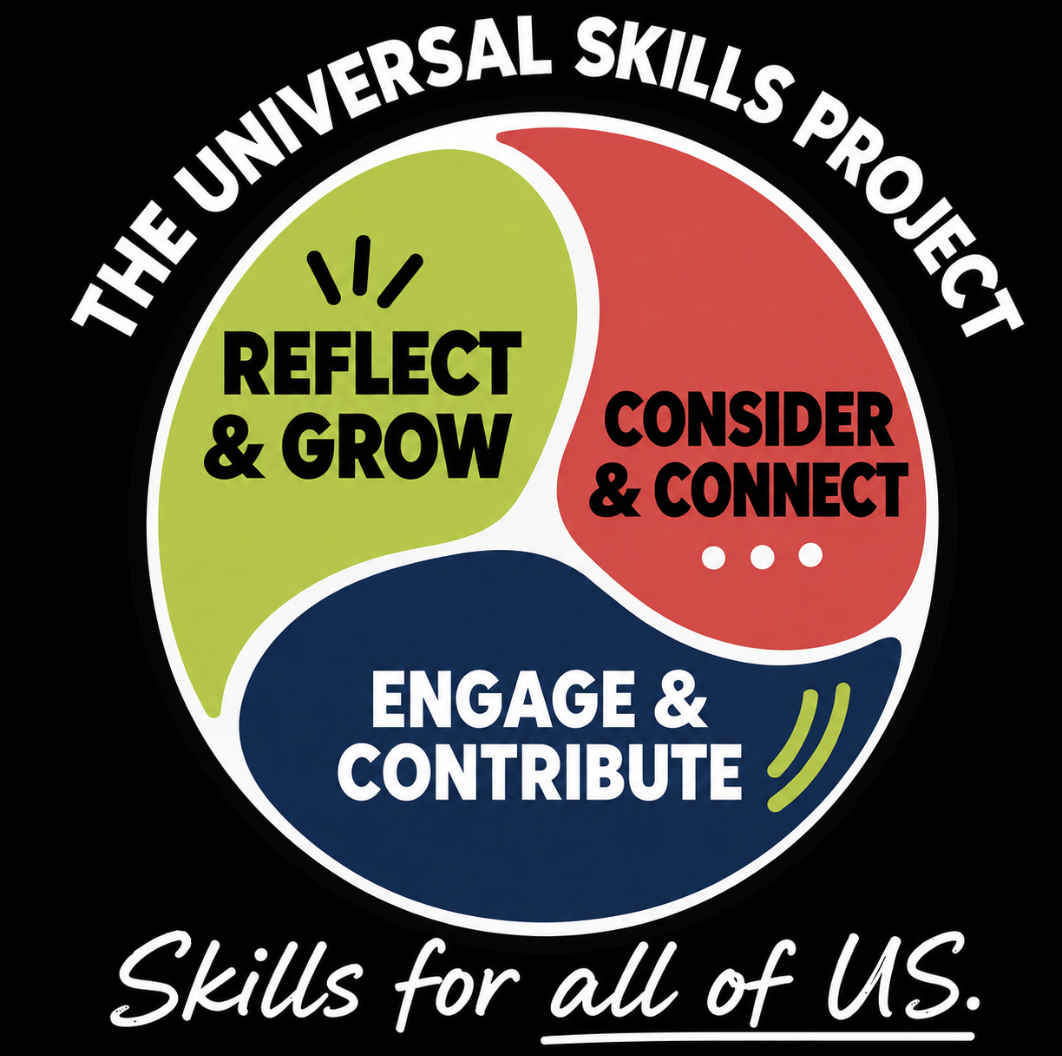
The Universal Skills Project, or The US Project, starts somewhere different.
These are not skills “we teach to them”. They are skills we practice together as a family or classroom or community.
Universal means universal.
A universal skill should be as meaningful at age seven as it is at seventeen, thirty-seven, or seventy-seven. It should matter at home and at school, in a friendship and in a workplace, in a family and in a community.
The context changes; the skill does not.
That is why we ask three questions when deciding whether something belongs in the framework:
Can a 7-year-old and a 47-year-old both continually grow this skill?
Does it matter across home, school, work, relationships, and community?
Can we describe it without judging personality, obedience, or conformity?
These questions deliberately push us away from language that depends on hierarchy.
Words like respectful and appropriate can sound positive while concealing an important question: According to whom?
What one person calls “respectful” or "appropriate" may reflect culture, power, preference, context, or an expectation of compliance rather than a universal human capacity.
The US Project tries to name the skill underneath the judgment. For example, we use the word “consider” instead of “respectful” because “considering someone else’s needs and wants” is an active and non-judgmental skill with a choice of attached actions.
When we “consider” another person, we practice noticing impact, considering another person's perspective, listening, making room for others, recognizing boundaries, caring for shared spaces, communicating clearly, and repairing harm
Those are things we can actually examine and practice. More importantly, they apply equally to everyone in the room. We don't need different language for different ages.
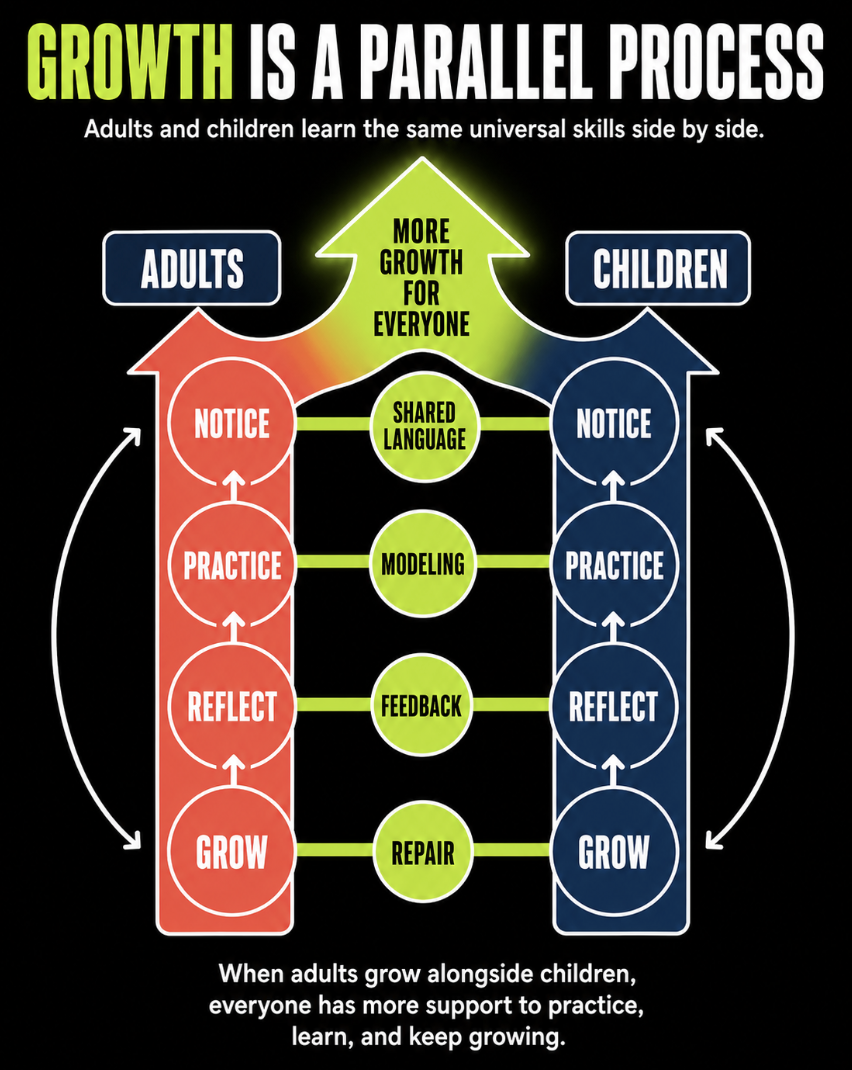
When adults and young people use the same language, something powerful becomes possible: growth can happen in parallel.
A child can be working on self-regulation while a parent is working on self-regulation.
A student can be learning to consider impact while a teacher considers their own impact.
A teenager can practice receiving feedback while a supervisor practices receiving feedback.
A school can work on adaptability at the same time the people within it do.
A family can practice conflict and repair together.
The complexity changes with age, experience, context, and responsibility—but the underlying human work is shared.
Everyone knows what we are working on. Everyone can identify where they are growing. And no one gets to graduate from being human.
Shared language also makes growth easier to recognize across contexts. When the same concepts appear at home, at school, in organizations, and in communities, people don't have to continually translate between systems. They can recognize the same capacity in different situations and practice it repeatedly. We are not developing people in isolation; we are developing alongside one another.
Modeling instead of managing.
There is another important shift at the heart of The US Project: from “managing other people's behavior” toward taking responsibility for our own.
James Baldwin captured this problem beautifully when he wrote:
“Children have never been very good at listening to their elders, but they have never failed to imitate them.”
That idea asks something much harder for adults than creating better rules for children.
If I want a child to regulate their emotions, what does my regulation look like when I am frustrated?
If I want someone to listen to me, how well do I listen when I disagree?
If I want young people to admit mistakes, what do they see me do when I am wrong?
If I want a team to remain curious instead of defensive, what happens when someone questions my idea?
If I want people to repair harm, can I recognize my own impact, apologize, and change what I do next?
The focus shifts from:
How do I get you to behave differently?
to
What skill can I practice here?
That shift matters because attempting to control someone else's behavior can quickly reproduce the very dynamics we are trying to change. It can reduce autonomy, create resistance, and position one person as the evaluator of another. Focusing on our own practice preserves something essential: each person's agency.
I can consider you. I can communicate with you. I can establish my own boundaries. I can offer feedback. I can contribute. I can repair the harm I have caused. I can change my own behavior. I can invite you into the process.
But I cannot do your growing for you.
The framework is not a behavior code.
The Universal Skills Project is therefore not intended to define what a "good student," "good employee," "good parent," or "good person" looks like. It is not a more sophisticated list of behaviors adults would like children to demonstrate.
It is a framework for human capacity.
That distinction changes the language. We become less interested in whether someone looks compliant and more interested in what is happening underneath:
Are they developing the capacity to regulate themselves?
Can they identify what matters to them?
Can they consider another perspective without abandoning their own?
Can they recognize their impact?
Can they stay curious when they don't know?
Can they identify and solve problems?
Can they make meaning from what they encounter?
Can they communicate what they think, feel, need, and understand?
Can they repair something when it goes wrong?
These questions leave room for personality, culture, neurodiversity, age, context, and individual expression. Two people can demonstrate the same universal skill very differently.
From changing others to growing together.
This may ultimately be the most important difference.
The US Project does not divide a community into people who teach the skills and people who need the skills.
We all need the skills.
A teacher doesn't teach self-regulation from outside self-regulation. A parent doesn't teach communication from outside communication. A leader doesn't create a collaborative organization by telling everyone else to collaborate. The culture of a classroom, family, workplace, or organization emerges in large part from what people repeatedly experience and see modeled around them.
So the framework asks adults to participate fully—not as perfect examples, but as visible learners.
An adult can say, I didn't listen well there. I'm going to try again.
A leader can say, I made that decision too quickly. I need to seek another perspective.
A parent can say, I'm getting frustrated, so I'm going to regulate myself before we keep talking.
A child can watch an adult recognize impact and make a repair.
That transparency makes the skills real. We don't demonstrate competence by pretending we have finished developing. We demonstrate it by showing what growth looks like.
And when individuals begin focusing on the skills they themselves can practice, rather than primarily identifying what everyone around them needs to change, something larger can happen. Families change. Classrooms change. Teams change. Organizations change. Systems change.
Not because everyone has been successfully controlled into behaving the same way, but because more people have the language, capacity, and autonomy to recognize problems and participate in solving them.
That is the idea behind The Universal Skills Project:
The skills are universal.
The language is shared.
The practice is personal.
The growth is collective.
“Children have never been very good at listening to their elders, but they have never failed to imitate them.”
James Baldwin, Writer and Civil Rights Activist